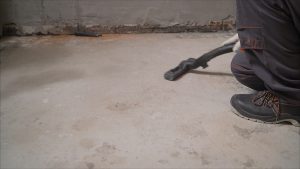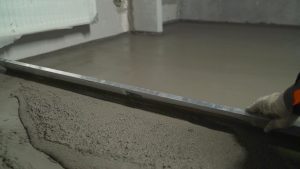
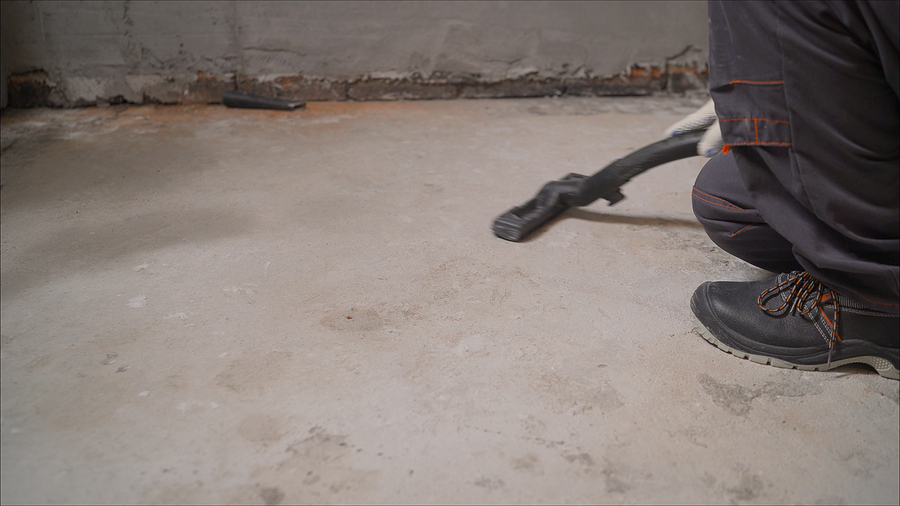
Removing an old floor can bring a few surprises. One of the stranger ones happens when the leveling compound starts coming up and the surface underneath looks red, pink, orange, or unusually chalky. Run a hand across it and you may even come away with powder on your fingers.
So, why might concrete appear red or chalky under an old floor leveling layer? There are several possibilities. The color could come from an old primer, moisture-control product, pigment, or previous flooring material. A chalky surface, on the other hand, may indicate efflorescence, laitance, weak concrete, or another material that needs removal before rebuilding the floor.
The appearance alone usually isn’t enough to make the call. What matters is figuring out exactly what is underneath the old leveling material and whether that surface is strong enough to support the next flooring system.
The Red Material May Not Actually Be the Concrete
The first assumption is often that the concrete itself has somehow turned red. That isn’t always what happened.
Flooring systems can have several layers that disappear from sight once the finished floor is installed. Contractors may have used primers, moisture barriers, adhesives, patches, or other products between the original slab and the leveling compound.
Some of those products are intentionally colored.
For example, certain moisture-control and flooring primers are manufactured with a red or magenta tint so installers can see where the material has been applied. MAPEI’s Planiseal MSP is specifically described as red, while its Primer T is magenta. Sika also manufactures red-tinted moisture-control products used below flooring systems.
That means a red layer uncovered during flooring removal could simply be evidence of an earlier flooring installation.
There is another possibility too. Concrete itself can be intentionally colored. Iron oxide pigments have long been used to produce red shades in concrete, so an older slab or topping may have been colored when it was installed.
The color is a clue, but it isn’t a diagnosis.
Why Does the Surface Feel Chalky?
The powder is more important.
If you can rub the floor and easily produce dust, the material at the surface may not be strong enough to bond reliably with a new leveling compound, coating, or adhesive.
One potential culprit is laitance.
Laitance is a weak layer of fine cement particles and other materials that can form at the surface of concrete. It may look fairly solid until grinding, scraping, or demolition exposes how weak it actually is.
Flooring products should not simply be installed over it. Industry surface-preparation guidance calls for loosely bound material and laitance to be removed so coatings and other systems can bond to sound concrete.
This is one reason a floor that appeared perfectly normal for years can suddenly look questionable once everything covering it has been removed.
It Could Be Efflorescence
A chalky surface does not always mean that the concrete itself is breaking apart.
Sometimes the powder is efflorescence.
Efflorescence occurs when moisture moves through cementitious material and carries soluble salts toward the surface. As the moisture evaporates, those salts are left behind. The result can be a white, grayish, or chalky deposit.
That makes moisture an important part of the investigation.
If an old leveling layer comes off and there is unusual powder underneath, simply sweeping the floor and pouring another leveler may not address the reason the material appeared in the first place.
The Original Leveling Job May Have Failed at the Bond
Sometimes the problem isn’t the slab. It is the way the old floor leveling system was installed.
Self-leveling materials need the right conditions to bond properly. The concrete has to be clean, sound, prepared correctly, and generally primed according to the leveling-product manufacturer’s instructions.
Custom Concrete Prep & Polish notes that inadequate surface preparation and priming can contribute to problems with underlayments. Proper preparation may involve grinding or scarifying high areas and filling low areas before the next flooring system is installed.
If the original installer poured leveling material over dust, laitance, contamination, a weak surface, or an incompatible material, the bond may have been compromised from day one.
Years later, the floor comes apart during demolition and exposes that weak interface.
You might see sections of leveling compound popping off almost intact while a dusty residue remains behind. That is a much different situation from removing a well-bonded underlayment that has to be mechanically ground away.
Carbonation Can Also Create a Weak Surface
There is another less obvious possibility.
Certain conditions during concrete curing can create a weak layer of calcium carbonate at the surface through a process called carbonation. MAPEI’s technical guidance notes that this type of weak surface can act as a bond barrier. It also recommends mechanically removing concrete that shows signs of crumbling, scaling, laitance, or similar weakness before installing a self-leveling underlayment.
For someone looking at an old floor, the cause may be impossible to identify simply by looking at it.
What matters more is whether the questionable layer is firmly bonded.
If it powders under light abrasion or easily separates from the slab, putting another flooring system directly over it can leave the new installation dependent on an already weak layer.
Can You Just Put New Leveler Over It?
Usually, this is where caution pays off.
A new leveling material can only bond as well as the surface supporting it. If that surface consists of loose powder, failing primer, weak concrete, old adhesive, or poorly bonded material, covering everything with another layer doesn’t make the underlying problem disappear.
It may simply bury it again.
The better approach is to determine where the sound concrete begins.
That may require mechanical surface preparation such as grinding, scarifying, or shot blasting. The exact method depends on what is on the floor, how strongly it is bonded, the condition of the slab, and what flooring system is going back down.
Custom Concrete Prep & Polish provides concrete surface preparation as well as floor leveling, moisture mitigation, coatings, and other concrete flooring services throughout the Denver area and Mountain West region.
Don’t Ignore Moisture
If the chalkiness appears to be associated with moisture or mineral deposits, it may also be worth evaluating the slab before installing another moisture-sensitive flooring system.
Concrete can look dry while still transmitting moisture vapor.
That becomes particularly important when the next floor includes adhesives, coatings, hardwood, resilient flooring, or other materials that can be affected by excess slab moisture.
Moisture mitigation systems exist specifically for these situations. They are designed to address moisture transmission before the finished flooring goes down rather than hoping the flooring itself will tolerate it.
CCPP offers moisture mitigation as part of its concrete preparation services, which allows the underlying slab condition to be addressed as part of the overall flooring plan rather than as a separate problem discovered later.
What Should Happen Before the New Floor Goes Down?
Once an old leveling layer is removed, the exposed substrate should be evaluated before anything replaces it.
Loose material needs attention. Old contaminants or incompatible products may need to come off. Hollow or poorly bonded areas should not simply be covered. The floor may also need grinding or another form of mechanical preparation to reach clean, solid concrete.
After that, the slab can be repaired or leveled according to the requirements of the flooring system being installed.
It isn’t always the fastest part of a flooring project, but it is one of the most important.
A beautiful finished floor doesn’t have much of a chance if the layers underneath it are already coming apart.
Find Out What Is Under the Floor Before Covering It Again
So, why might concrete appear red or chalky under an old floor leveling layer? The red color may come from an old primer, moisture barrier, flooring product, or pigment in the concrete itself. A chalky texture may be caused by efflorescence, laitance, carbonation, weak cementitious material, or a poorly bonded previous installation.
The real question isn’t whether the floor looks unusual. It is whether the substrate is clean, dry enough for the intended system, structurally sound, and properly prepared for whatever comes next.
At Custom Concrete Prep & Polish, we handle the work that happens before the finished flooring is installed, including floor leveling, concrete grinding, surface preparation, moisture mitigation, and coatings. If you’ve uncovered an old flooring system and aren’t sure what you’re looking at, contact us to discuss the project and determine the right way to prepare the concrete.