Walk across an older garage, and you may notice something doesn’t feel quite right. One section sinks slightly underfoot. Two parts of the slab meet at different heights. You may notice a ridge where one side of a crack sits higher than the other.
These problems are easy to lump together as an “uneven floor,” but they aren’t necessarily the same thing. A shallow dip may only require surface correction. You can address a raised step by grinding. Differential settlement, where one section of concrete has moved relative to another, deserves a closer look because the slab itself may have shifted.
So, how do you fix a garage floor that has a dip, step, or differential settlement? The answer starts with determining what caused the elevation difference and whether the concrete has stopped moving. Once that is understood, grinding, patching, floor leveling, or a combination of methods may be able to create a smooth surface without replacing the entire garage floor.
First, Figure Out What Kind of Problem You Have
Not every low spot means the slab has settled.
Concrete garages are rarely perfect. Minor variations can happen when the slab is originally poured and finished. Over time, those imperfections may become more noticeable, especially when you’re preparing the garage for cabinets, flooring, an epoxy coating, or another finished surface.
A dip is generally a localized low area. The concrete around it may be perfectly sound and stable.
A step is different. This occurs when adjacent areas sit at noticeably different elevations. You might see it at a joint, crack, patch, or transition between separate concrete placements.
Then there is differential settlement. That’s when one portion of a slab moves downward more than another. Instead of the entire floor settling uniformly, one area ends up lower, creating a slope, ridge, or uneven transition.
Those distinctions matter because you don’t want to treat every problem by simply pouring more material on top.
Custom Concrete Prep & Polish begins its floor-leveling work by evaluating existing conditions and identifying the areas that need correction before determining the appropriate approach.
A Small Dip May Be Fairly Straightforward
A stable depression in an otherwise solid garage floor may be one of the simpler issues to address.
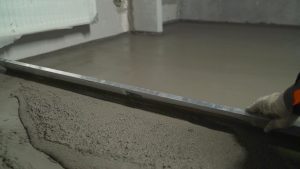
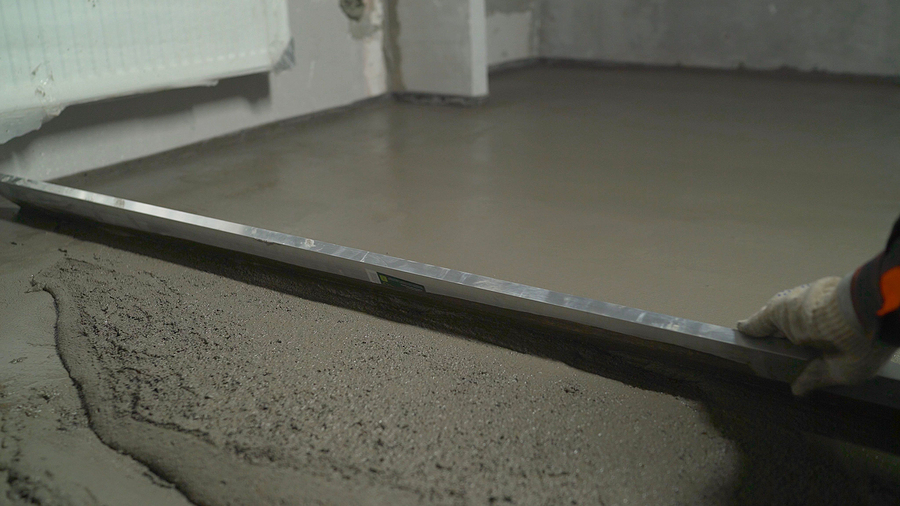
Rather than removing and replacing the surrounding concrete, a contractor may be able to prepare the existing slab and fill the low area with an appropriate cementitious repair or leveling material.
How much correction is needed depends on the depression’s depth and size.
One shallow low spot does not necessarily justify covering the entire garage with leveling material. In some situations, you can localize the repair and blend it into the surrounding floor.
For larger areas, a leveling underlayment or topping may make more sense.
Either way, you need to prepare the old concrete correctly first. Putting new material over oil, dust, weak concrete, old coatings, or other contaminants creates another potential failure point.
ICRI guidance emphasizes that concrete repair and coating surfaces should be clean, sound, and prepared to the appropriate profile before installing new material.
What If One Side of the Floor Is Higher?
A raised edge or step often calls for a different strategy.
Instead of building everything else up to meet the highest point, it may make more sense to remove some concrete from the elevated area.
This is where concrete grinding can be useful.
Diamond grinders can reduce high spots and smooth minor elevation differences. ICRI identifies grinding as a method to smooth slight surface irregularities and remove coatings and other surface materials.
Custom Concrete Prep & Polish takes a similar approach to floor leveling. Depending on the floor, the company may grind or scarify high sections and fill lower sections until the surface meets the requirements of the flooring being installed.
Sometimes this approach saves a considerable amount of leveling material.
Imagine one portion of the garage is 1/4 inch too high while an adjacent section is 1/4 inch low. Raising the entire surrounding floor to meet the highest point could create new problems at doors, thresholds, or the driveway.
Reducing the high point first may make the rest of the correction much more manageable.
Differential Settlement Needs a Closer Look
This is where the situation becomes more complicated.
If one slab section has actually settled relative to another, there is an important question to answer before correcting the surface:
Is it still moving?
If the movement happened years ago and the slab has remained stable ever since, surface correction may be enough to make the garage usable again.
If the slab continues to settle, however, simply grinding the step or filling the low section may only hide the symptom temporarily.
Voids beneath slab edges can sometimes contribute to movement. Concrete repair literature discusses methods of filling voids below slab sections before grinding uneven joints so the slab is better supported.
The exact remedy depends on the cause and severity of the movement. In more substantial cases, a structural or concrete repair professional may need to address the underlying support before floor-leveling work begins.
This is one of those situations where diagnosing the problem first can prevent paying to correct the same floor twice.
Cracks Can Tell You Something Too
A crack running through an uneven area deserves attention.
A narrow, old crack that hasn’t changed in years differs from one that keeps widening or shows obvious vertical displacement.
Look at the two sides.
Are they still at approximately the same elevation? Or has one side dropped?
The second situation may indicate movement rather than ordinary shrinkage cracking.
That doesn’t automatically mean the entire garage slab needs to come out. It does mean the floor should be evaluated before someone simply fills the crack and coats over it.
A coating can improve a garage’s appearance, but it cannot stop an unstable slab from moving underneath it.
Sometimes the Best Repair Uses More Than One Method
Uneven garage floors don’t always present one neat problem.
You might have a raised joint near the center of the garage, a low section near a wall, and a rough patch left behind from an earlier repair.
In that situation, one product or one machine may not solve everything.
A contractor might grind down the raised area first, mechanically prepare the rest of the concrete, patch damaged sections, and then use leveling material where additional height needs to be added.
That is often more practical than trying to force one repair method to handle the entire floor.
CCPP’s floor-leveling process specifically combines removal of high areas with filling low sections when the conditions call for it. The company also uses grinding and shot blasting equipment to prepare concrete for coatings, overlays, and self-leveling materials.
Don’t Forget About the Garage Door and Drainage
Fixing one problem shouldn’t create another.
Garages often need some amount of slope for water management. If the floor currently drains toward the garage door or a floor drain, making the entire surface perfectly level may interfere with that drainage.
Finished elevation matters too.
Adding substantial material can raise the floor around:
- Garage doors
- Entry doors
- Floor drains
- Steps
- Cabinets
- Driveway transitions
- Utility equipment
This is why floor leveling isn’t necessarily about getting every point in the garage to exactly the same elevation.
Sometimes the objective is simply to remove an abrupt transition, correct an isolated depression, or create a flatter substrate while maintaining the slope the garage needs.
What If You’re Planning a Garage Floor Coating?
This is often when homeowners first notice how uneven their concrete really is.
Epoxy, polyaspartic, and other floor coatings aren’t designed to correct major dips or steps. They generally follow the contours of the prepared surface.
If there is a noticeable ridge before the coating goes down, it will likely still be noticeable afterward.
Floor correction should therefore happen during the preparation stage.
This gives the contractor an opportunity to evaluate cracks and elevation differences, grind where needed, repair low areas, and create the appropriate surface profile before installing the finished coating.
Custom Concrete Prep & Polish provides floor leveling alongside epoxy coatings, polyaspartic coatings, moisture mitigation, and concrete surface preparation, so the condition of the substrate can be addressed before the finished flooring system goes down.
Does an Uneven Garage Floor Have to Be Replaced?
Not necessarily.
People sometimes see a dip or vertical step and immediately assume they are facing a complete tear-out. Depending on the concrete’s condition, that may be far more work than the floor actually needs.
Grinding can reduce high areas. Cementitious materials can build up low areas. A combination of the two can sometimes dramatically improve transitions without removing the slab.
Replacement or more substantial repair becomes more likely when the concrete is badly deteriorated, movement is ongoing, sections are no longer adequately supported, or the elevation difference is too significant to correct practically from the surface.
The slab’s condition determines the answer.
Fix the Cause Before You Fix the Appearance
So, how do you fix a garage floor that has a dip, step, or differential settlement? Start by finding out what created the uneven area.
A stable dip may be filled. A high spot may be ground down. A combination of grinding and leveling can address floors with several different elevations. If differential settlement is responsible, you may need to address the underlying movement before correcting the surface.
That extra evaluation makes a difference. There is little value in creating a beautifully smooth garage floor over concrete that is still moving.
Custom Concrete Prep & Polish specializes in floor leveling, concrete grinding, surface preparation, epoxy and polyaspartic coatings, moisture mitigation, and other concrete flooring solutions throughout Denver, Arvada, and the Mountain West region.
If your garage has a dip, raised transition, or uneven slab and you’re not sure what repair it needs, contact Custom Concrete Prep & Polish to have the floor evaluated and discuss the best way to prepare it for what comes next.