A garage floor that slopes the wrong way can become annoying fast. Water may collect along a wall instead of heading toward the garage door. Cabinets wobble. A workbench never seems to sit quite right. In some cases, an uneven surface can even complicate plans for a new epoxy or polyaspartic coating.
That leads to an obvious question: ‘Is it possible to correct garage floor slope without replacing the slab?’
Often, yes.
If the existing concrete is structurally sound, contractors may be able to improve the floor using a combination of concrete grinding, patching, resurfacing, or cementitious leveling materials. Complete slab replacement is generally reserved for more serious situations, such as substantial settlement, severe deterioration, or movement that cannot be corrected at the surface.
The first step, however, is determining whether the slope actually needs to change.
A Garage Floor Isn’t Always Supposed to Be Perfectly Level
This is an important distinction.
A garage floor can be flat without being level.
Many garage slabs have some degree of intentional pitch so water can move toward the garage door or a drain rather than remaining inside the building. Snow melting off a vehicle, rainwater, and water brought in during cleaning all need somewhere to go.
So, if a garage floor slopes slightly toward the door and drains properly, that slope may be doing exactly what it was designed to do.
The problem is when the floor pitches toward the house, creates isolated low spots, lets puddles remain, or becomes uneven because part of the slab has settled.
Before changing anything, evaluate the existing elevations and drainage pattern.
Grinding Can Take Down High Areas
Sometimes what feels like a sloping floor is actually a relatively flat slab with one or two high areas.
Concrete grinding can be useful in this situation.
Diamond grinding equipment removes concrete from elevated areas in a controlled way. By reducing a hump or high transition, it may be possible to make the overall surface flatter without adding a thick layer across the entire garage.
Custom Concrete Prep & Polish uses concrete grinding as part of its floor-leveling process. Depending on the existing conditions, the company can grind or scarify high areas and fill low areas until the surface meets the specifications required for the flooring system being installed.
Grinding also serves another purpose when a new coating or topping is planned. It can remove existing material and prepare the surface so the next product has sound concrete to bond to.
In other words, sometimes fixing the slope means removing material rather than simply adding more.
Low Areas Can Often Be Built Up
What happens if the opposite problem exists?
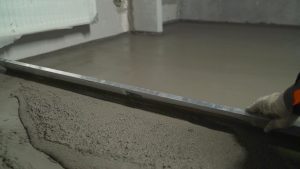
A low section may sometimes be filled or resurfaced with a cementitious material instead of removing the entire slab.
Various patching compounds, underlayments, and concrete toppings are manufactured to correct elevation differences. Some products can even be tapered into the surrounding concrete so the transition isn’t abrupt.
For example, ARDEX manufactures cement-based leveling products that can be installed over properly prepared existing concrete. Some can fill significant elevation differences, depending on the product and application.
For garage applications, product selection matters considerably.
A typical interior self-leveling underlayment isn’t automatically suitable for the exposed surface of a garage. Many underlayments are designed to sit underneath another flooring material rather than withstand vehicle traffic, moisture, road salts, or other conditions associated with garages.
However, cementitious toppings are available for tougher environments. ARDEX K 301, for example, is designed for interior and exterior concrete resurfacing, can be used in wet areas, and can be installed in residential and light-industrial applications.
That is why choosing the right material is just as important as deciding how much to install.
What About Self-Leveling Concrete?
The name makes self-leveling concrete sound like the obvious answer for any sloped garage.
It isn’t quite that simple.
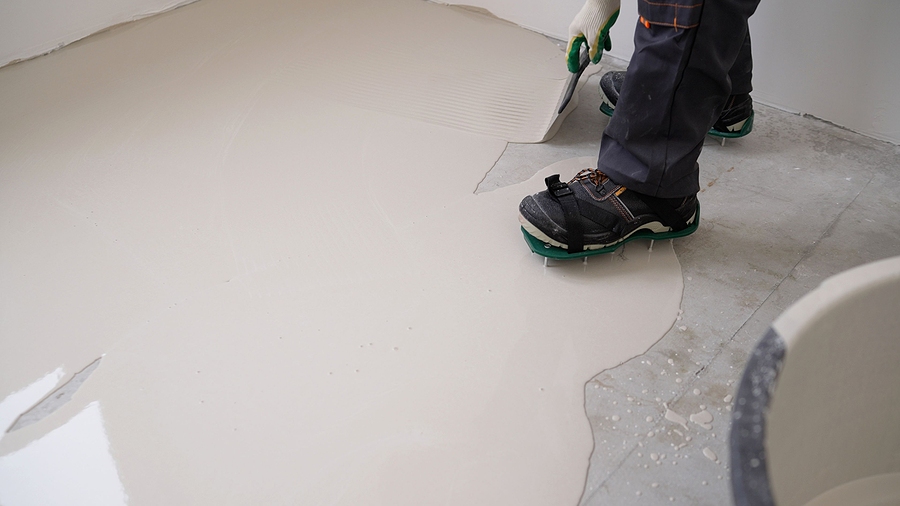
A self-leveling product naturally wants to flow toward a level plane. That’s helpful when you’re trying to correct dips or create a flat substrate for another flooring system. It can be less helpful when the garage needs to retain a deliberate pitch toward the door or drain.
Pouring a self-leveler across the entire floor without accounting for drainage could potentially remove a useful slope along with the unwanted irregularities.
Sometimes the goal isn’t actually to make the garage perfectly level.
It may be to make it flatter and more consistent while preserving the drainage pitch.
That requires more planning than simply pouring material into the lowest point.
A Combination Approach May Make More Sense
For some garages, the best solution isn’t grinding or filling. It is both.
Imagine a garage that has one raised area along a joint and a depression several feet away. Filling the entire floor up to the highest point could require a substantial amount of material and unnecessarily raise the finished elevation.
Instead, the high area might be ground down first. Then fill the remaining low sections.
That can reduce the amount of leveling material required while creating a smoother transition across the floor.
Custom Concrete Prep & Polish specifically describes this type of approach as part of its floor-leveling services, using grinding or scarifying for high areas and filling lower sections where needed.
The right combination depends on how far the floor varies from one area to another.
Surface Preparation Still Matters
Adding material to concrete doesn’t automatically mean it will stay there.
The existing slab has to provide a suitable bonding surface.
Garage floors can be especially challenging because they may contain oil, old coatings, curing compounds, tire residue, sealers, or other contaminants. Putting a leveling product over those materials without adequate preparation can result in a weak bond.
Mechanical surface preparation removes questionable surface material and opens the concrete.
CCPP uses grinding and shot blasting equipment for concrete surface preparation. According to the company, shot blasting creates a roughened profile that helps coatings, self-leveling underlayments, and cementitious overlays adhere properly.
That preparation isn’t just an extra step before leveling. It is part of what makes the correction work.
Why Is the Garage Sloping in the First Place?
Before correcting a floor, it is worth asking how it ended up that way.
Maybe the slab has always had that slope.
Maybe one area was finished unevenly during the original pour.
Or something may have changed beneath the concrete.
Settlement can cause one section of a garage floor to drop. Soil movement, erosion, poorly compacted fill, moisture conditions, or other underlying issues may contribute.
That distinction matters because an overlay can correct the surface elevation, but it cannot stabilize a slab that is still actively moving.
If part of the garage has dropped substantially, cracks continue to change, or sections of concrete appear to be moving independently, the problem may require structural or slab-repair work before cosmetic leveling makes sense.
Covering an unstable slab simply creates a new surface over the same unresolved problem.
Door Clearance and Transitions Can Limit Your Options
There is another issue that doesn’t get much attention until the leveling material is already on the floor: height.
Adding material raises the finished elevation.
That can affect:
- The garage door and weather seal
- Doorways leading into the house
- Floor drains
- Steps and thresholds
- Cabinets or built-in storage
- Transitions to driveways or adjoining slabs
Even a relatively small change can matter near a doorway.
This is another reason grinding down high areas can sometimes be preferable to building the entire floor upward.
The correction needs to work with the rest of the garage, not just make a bubble level read perfectly.
What If You Want an Epoxy or Polyaspartic Floor?
Slope and surface irregularities become particularly noticeable once a new coating is installed.
A coating generally follows the shape of the substrate underneath it. It isn’t meant to correct major elevation changes on its own.
That means floor correction should typically happen during the preparation stage.
Once the slab has been evaluated, you can address high areas, repair low areas where appropriate, and prepare the concrete to receive the coating system.
CCPP provides both epoxy and polyaspartic floor coatings, along with concrete surface preparation and leveling services, allowing those parts of the project to be considered together rather than separately.
When Might Slab Replacement Be Necessary?
Not every sloped garage can be fixed from the surface.
Replacement or more substantial concrete repair may be worth considering if the slab has extensive structural deterioration, significant displacement, widespread cracking, or continued settlement.
In some cases, correcting a severe slope with an overlay may raise the floor too much to work with existing doors, drains, or surrounding elevations.
But an old, uneven, or poorly sloped garage floor does not automatically mean the slab has reached the end of its life.
A professional assessment can determine whether the concrete is still sound enough to work with.
Correct the Floor Without Starting Over
So, can you correct a garage floor slope without replacing the slab? In many cases, it is. High spots can sometimes be ground down, low areas can be filled, and cementitious toppings or leveling materials can be used to improve the surface. The important part is determining why the slope exists and whether the slab underneath is stable.
The goal isn’t necessarily to create a perfectly level garage. The goal is to create the right surface for how the garage is used while maintaining necessary drainage and transitions.
Custom Concrete Prep & Polish provides professional floor leveling, concrete grinding, surface preparation, epoxy coatings, polyaspartic coatings, and related concrete flooring services throughout Denver, Arvada, and the surrounding Mountain West region.
If your garage floor has low spots, an awkward slope, or uneven areas, contact Custom Concrete Prep & Polish to discuss whether we can correct the existing slab without tearing it out and starting over.