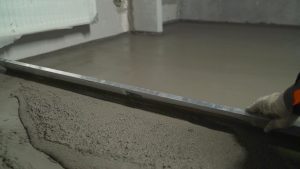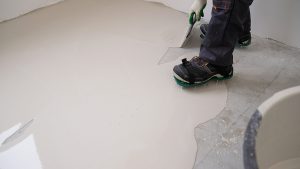
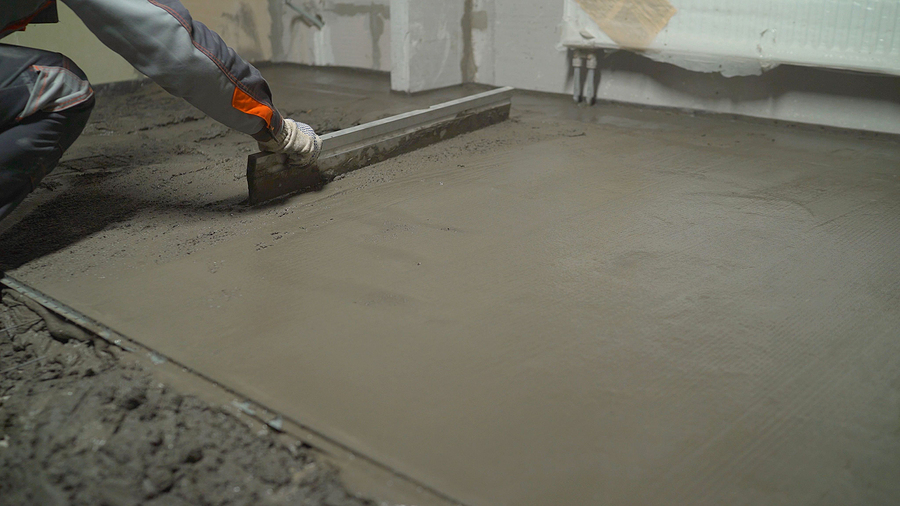
You have one bad spot in an otherwise usable garage floor. Maybe there is a dip where water collects, a rough patch left from an old repair, or a low area that you would like to smooth before coating the floor. Using self-leveling underlayment seems like an easy fix. Pour it into the low spot, let it flatten itself out, and you’re done.
There is one problem. A garage isn’t a bedroom or office.
Cars bring weight, moving tires, road grit, water, temperature changes, and sometimes oil or chemicals onto the floor. A material that works perfectly well beneath tile or vinyl may not be designed to take that kind of abuse directly.
So, can self-leveling underlayment survive vehicle traffic when used to smooth a garage spot repair? A conventional self-leveling underlayment usually should not be left exposed to vehicle traffic. However, there are specialized self-leveling toppings and repair products specifically engineered for traffic-bearing surfaces. The product, preparation, repair thickness, and final flooring system all matter.
Self-Leveling Underlayment and Self-Leveling Topping Are Not the Same Thing
This is probably the most important point to understand.
People often use “self-leveler” as a catch-all term, but manufacturers make these products for very different purposes.
A traditional self-leveling underlayment is designed to create a flat, smooth substrate beneath another flooring material. Once it cures, you can install tile, carpet, resilient flooring, wood, or another approved finish on top.
But Some Self-Leveling Products Can Handle Vehicles
This is where the answer gets more interesting.
There are cementitious products that look and install somewhat like conventional self-leveling underlayments but are engineered as toppings or traffic-bearing surfaces.
MAPEI’s Ultratop PC, for instance, is a self-leveling cementitious topping designed as a durable finished surface and is rated for light vehicular traffic in residential, commercial, and light-industrial applications.
Other manufacturers offer traffic-bearing products with similar capabilities.
The important word here is rated.
A material shouldn’t be chosen simply because the bag says “self-leveling” or because it has a high compressive-strength number. The technical data should specifically support the conditions in which the repair will be used.
A garage floor repair sees different stresses than a floor beneath carpet.
High Compressive Strength Doesn’t Tell the Whole Story
It is tempting to look at a product rated at several thousand psi and assume it’s strong enough for a car.
That number doesn’t tell the whole story.
Vehicle tires create rolling and turning forces against the surface. Hot tires can also place additional stress on certain flooring systems. If the material is poorly bonded to the original slab, the repair can separate even though the leveling compound itself has impressive compressive strength.
Then there are the edges.
A small spot repair may taper into the existing slab. Those thin transitions can become vulnerable if the product isn’t designed to feather appropriately or if the concrete beneath them wasn’t prepared correctly.
That’s why the manufacturer’s intended use matters just as much as the strength listed on the bag.
What Happens If You Use the Wrong Self-Leveler?
It might look great at first.
That’s part of the problem.
A freshly poured leveling compound can produce an impressively smooth repair. You may drive across it for a while without seeing anything happen.
Then the edges begin to chip.
A tire turns while the vehicle is stationary and breaks loose a small section. Powder develops around the repair. The material starts separating from the concrete underneath. Eventually, what began as a small low spot turns into another repair project.
This doesn’t mean self-leveling materials are bad products. It means the wrong material was asked to perform a job it wasn’t designed to do.
Some conventional underlayments are explicitly intended to be protected until the finished flooring is installed. MAPEI’s PlaniLevel 450, for example, can tolerate rubber-wheeled traffic after its prescribed curing period during installation, but the manufacturer still states that it should not be used as the final wear surface and must be covered by a finished flooring system.
That distinction is easy to miss.
Being strong enough to tolerate temporary construction traffic is not necessarily the same as being designed as your permanent garage floor.
A Spot Repair Has to Bond to the Existing Concrete
Even the right product can fail if the concrete underneath it isn’t ready.
Garage slabs aren’t exactly clean environments. Over the years, the floor may have collected oil, grease, tire residue, paint, old coatings, curing compounds, sealers, or contaminants that have soaked into the surface.
New cementitious material needs to bond to sound concrete, not to whatever happens to be sitting on top of it.
That usually makes mechanical preparation an important part of the repair.
Custom Concrete Prep & Polish uses concrete grinding and other surface-preparation methods to remove high areas, contaminants, coatings, and weak surface material before installing flooring systems. For leveling work, high spots can be mechanically reduced while low areas are filled to create the required surface.
This is one reason a professional garage spot repair involves more than pouring material into a depression.
Sometimes Grinding Is Better Than Adding Material
Suppose the garage doesn’t really have a low spot. Instead, there is a hump nearby that makes the surrounding area appear low.
Pouring leveler into the lower section might technically smooth the transition, but now you have raised a larger portion of the floor to compensate for one high point.
Grinding the high area may be the simpler solution.
Sometimes the best repair combines both methods. A contractor can reduce a high edge first and then use an appropriate repair material to smooth the remaining low section.
This keeps the repair from becoming thicker or larger than necessary.
It can also help preserve important elevations around the garage door, driveway, steps, and home entrance.
Garage Drainage Complicates the Word “Level”
Another thing to watch is the existing slope.
A garage floor isn’t always supposed to be perfectly level. Many garages are pitched so water moves toward the overhead door or a drain.
A self-leveling material, however, naturally seeks a level plane.
That creates a potential conflict.
If you pour conventional self-leveler into a larger garage area without considering the drainage pattern, you could correct one dip while unintentionally interfering with the floor’s intended pitch.
For a localized repair, the goal may be to smooth an abrupt depression while still following the garage’s overall slope.
That requires more control than pouring a bucket and letting the material find its own level.
What If an Epoxy or Polyaspartic Coating Is Going Over the Repair?
Now the repair becomes part of a larger flooring system.
If the garage will receive an epoxy, polyaspartic, or similar coating, the patching or leveling material needs to be compatible with that system.
This is where you want to think beyond the repair itself.
The existing concrete must be prepared. The low area needs the appropriate repair material. The repaired surface may then require additional profiling before the coating is applied.
Custom Concrete Prep & Polish installs epoxy and polyaspartic flooring systems in addition to providing concrete grinding, floor leveling, moisture mitigation, and surface preparation. This allows the garage slab condition and the final coating to be considered one system rather than separate jobs.
CCPP also notes that the choice of leveling product matters because some underlayments are not designed to function as a finished wear surface, while certain other products can be used that way.
What Should Be Used for an Exposed Garage Repair?
If the repaired area will remain exposed and vehicles will drive directly over it, look for a product specifically approved for that use.
The technical data should address factors such as:
- Vehicle or rubber-wheeled traffic
- Minimum and maximum installation thickness
- Interior or exterior exposure
- Required concrete preparation
- Priming requirements
- Moisture limitations
- Cure time before traffic
- Compatibility with coatings or sealers
Don’t assume that every cement-based leveling product has the same capabilities.
A true traffic-bearing topping is a different product category from an underlayment designed to disappear beneath another floor.
A Small Garage Dip Doesn’t Always Require a Big Repair
The good news is that an isolated garage floor problem doesn’t automatically mean you have to replace the slab.
A localized dip, rough section, or poor transition may be correctable by grinding, patching, resurfacing, or using an appropriate traffic-rated leveling material.
The slab’s condition determines the solution.
If the low spot developed because the concrete is actively settling, investigate the underlying movement first. Adding a perfectly smooth topping won’t stop unstable concrete from continuing to move.
If the slab is sound and the problem is limited to the surface or elevation, several much less disruptive options may be available.
Choose the Material for the Traffic It Will Actually See
So, can self-leveling underlayment survive vehicle traffic when used to smooth a garage spot repair? A standard underlayment generally shouldn’t be treated as an exposed garage wear surface unless its manufacturer specifically approves that use. Many are designed to be covered by another flooring material.
Traffic-rated self-leveling toppings are different. Certain products are engineered to withstand rubber-wheeled or light vehicle traffic and may be appropriate for garage applications when installed according to their specifications.
The safest approach is to match the repair material to the actual conditions rather than choosing a product simply because it flows and levels itself.
At Custom Concrete Prep & Polish, we work with uneven and damaged concrete every day. Our services include floor leveling, concrete grinding, surface preparation, epoxy and polyaspartic coatings, moisture mitigation, and other concrete flooring solutions for projects throughout Arvada, Denver, and the surrounding area.
If you have a dip or damaged spot in your garage floor, contact Custom Concrete Prep & Polish to find out which repair approach makes sense before you cover it, coat it, or start driving over it.