Pull up old carpet, vinyl, VCT, or another glued-down floor, and you may discover that removing the flooring was the easy part. What remains can look like streaks of hardened glue, gummy patches, dark mastic, or a thin film that seems permanently attached to the slab. If you’re applying a new epoxy, polyaspartic, or other bonded coating over that concrete, leaving residue behind is risky. What is the best way to remove adhesive residue from concrete before coating? In most cases, the process starts with removing as much bulk adhesive as possible, then mechanically grinding the concrete with tooling suited to the residue.
The goal is not simply to make the floor look cleaner. The coating needs direct contact with properly prepared concrete. If it bonds to old adhesive instead, the entire system’s strength may depend on glue installed years or even decades ago.
Why Does Old Adhesive Have to Come Off Before a Coating?
Adhesive is meant to create a barrier between two materials. That works when it holds flooring in place. It becomes a problem when you want a new coating to bond directly to the slab.
Even a relatively thin film can interfere with adhesion.
Custom Concrete Prep & Polish regularly encounters old carpet, vinyl, and tile adhesives during flooring removal. Because concrete is porous, some adhesives can also work into the surface rather than remaining neatly on top. A floor may look clean after scraping and still contain enough residue to cause problems later.
Coating manufacturers take contamination seriously for the same reason. Sherwin-Williams specifies that concrete receiving a coating should be sound, clean, dry, and free of contaminants that could interfere with adhesion.
You want the coating attached to concrete, not to whatever was left behind from the previous floor.
Should You Start With a Floor Scraper?
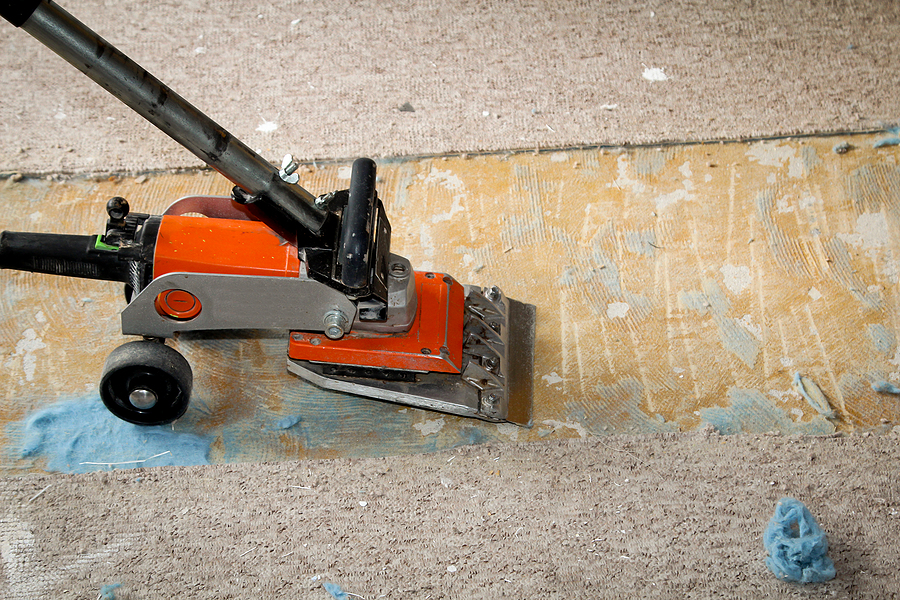
Usually. If thick ridges or layers of adhesive remain after flooring removal, it often makes sense to take off as much of that material as practical before bringing in the grinder.
Scraping can reduce the amount of material the grinding equipment has to process. The problem comes when you treat scraping as the finished preparation.
Run your hand across a scraped floor, and it may feel relatively smooth. Look more closely and you can often still see dark areas, swirls, or a faint haze where adhesive remains.
That residue matters.
Some glue also smears when friction heats it rather than breaking away cleanly. That is where professional tooling selection matters. Grinding sticky adhesive with tooling meant only for ordinary concrete can turn a straightforward removal job into a frustrating mess.
Why Is Mechanical Grinding Usually the Better Final Step?
Grinding does something scraping alone cannot: it removes remaining material while exposing fresh concrete underneath.
Custom Concrete Prep & Polish uses professional grinding equipment specifically to strip existing material and open the concrete surface before subsequent flooring treatments. The company also uses shot blasting where a rougher profile is required for coatings, overlays, or self-leveling materials.
Tooling matters as much as the machine.
For stubborn glue and coatings, specialized removal tooling may be used before conventional grinding begins. Husqvarna, for example, manufactures polycrystalline diamond, or PCD, tooling specifically for removing elastic contaminants such as glue and coatings from concrete.
Once the heavier adhesive is gone, the floor can be ground further as needed to remove remaining residue and create the surface condition the coating system requires.
This is why “grind the floor” is not really one step. It may involve different tooling and multiple passes depending on what is found.
What About Chemical Adhesive Removers?
Chemical removers sometimes have a place in the process, particularly when an adhesive needs to be softened before mechanical removal.
But there is a catch.
If the remover leaves behind an oily film or other chemical residue, you have traded one bond-breaking contaminant for another.
Custom Concrete Prep & Polish notes that solvents may occasionally be used strategically to soften difficult adhesive, followed by additional removal and mechanical preparation. The company also cautions that ordinary scraping, scrubbing, or chemical stripping can leave residual material behind on porous concrete.
That is why pouring adhesive remover across the floor and assuming the slab is ready to coat afterward is not a good preparation plan.
If you use chemicals, you still need to evaluate the remaining surface carefully and prepare it according to the requirements of the coating being installed.
Why Isn’t Pressure Washing Enough?
Because water can clean a surface without necessarily removing what is bonded to it.
Pressure washing may remove loose debris and some contamination, but stubborn flooring adhesive is another matter. Glue that has been sitting beneath carpet or tile for years may be strongly attached to the slab or partially embedded in its pores.
Custom Concrete Prep & Polish makes the same point about other contaminants: pressure washing can help clean, but it does not replace mechanical preparation when material needs to be removed from the concrete surface.
It also introduces moisture.
If you are preparing for a moisture-sensitive coating, adding a large amount of water immediately before installation can create another variable to manage. Sherwin-Williams also notes that water-based surface-preparation methods can contribute to moisture concerns and that concrete should meet the coating system’s moisture requirements before installation.
What Is Adhesive Ghosting?
Sometimes the glue is gone, but its history is not. Custom Concrete Prep & Polish calls this adhesive ghosting. Dark lines, squares, stains, or shadows can remain in the concrete where old carpet tile, vinyl, or other flooring was once bonded.
That happens because adhesive can penetrate below the immediate surface.
Ghosting is especially noticeable when concrete will be polished or finished decoratively, but embedded residue can also signal that preparation needs to go deeper before installing a coating.
A quick surface scrape may therefore give a false sense of progress.
Professional crews often use small test areas and observe how the slab behaves during grinding. If residue continues to smear, discolor the concrete, or remain below the initial pass, the removal strategy can be adjusted before the entire floor is prepared.
How Clean Does the Concrete Need to Be?
Clean enough for the new coating to bond to the slab rather than dirt, glue, sealer, old coating, wax, or other foreign material.
Another part of the equation, though, is surface profile.
A floor can be completely free of adhesive and still be too smooth for the coating being installed.
After removing the glue, the contractor must prepare the concrete to the profile required by the specific coating system. Grinding or shot blasting may be used depending on the floor and product. Custom Concrete Prep & Polish describes shot blasting as a method for creating the rough profile needed for strong adhesion of coatings, self-leveling underlayments, and cementitious overlays.
Think of adhesive removal as clearing the old floor away.
Surface profiling prepares the slab for what comes next.
Both matter.
What if the Adhesive Is Black and Very Old?
Stop before grinding it.
Older flooring materials and associated mastics can contain asbestos. You cannot reliably determine whether an adhesive contains asbestos simply by looking at its color.
OSHA regulations specifically address asbestos-containing resilient flooring and associated adhesive. Aggressive disturbance methods such as sanding, abrading, or grinding can create asbestos exposure concerns, and OSHA requires particular work practices when asbestos-containing flooring materials are involved.
If the flooring or adhesive is old enough to raise a reasonable concern, have it properly evaluated before mechanical removal begins.
This is one situation where “just grind it off” can be exactly the wrong approach.
Can You Coat Over a Little Adhesive That’s Really Stuck?
It may be tempting, especially when only a few stubborn patches remain.
The better question is whether the coating manufacturer approves bonding over that material.
Usually, relying on unknown old adhesive in a new coating system is an unnecessary gamble. Even if the glue itself appears well bonded today, you may know very little about its chemistry, age, moisture resistance, or compatibility with the coating being installed.
If that old layer releases later, the new coating can come with it.
Sherwin-Williams surface-preparation guidance emphasizes removing contaminants and incompatible existing materials before coating because preparation directly affects adhesion and service life.
Grinding another stubborn area now is considerably easier than repairing a peeling floor later.
How Do Professionals Know When the Floor Is Ready?
They do not judge it only by whether the floor looks clean from across the room.
They inspect the slab as preparation progresses. Remaining adhesive, embedded contamination, weak concrete, cracks, previous patches, moisture concerns, and the condition of the exposed surface all influence the next step.
Custom Concrete Prep & Polish emphasizes surface preparation for exactly this reason. Grinding removes existing material and opens the concrete, while additional preparation methods can create the profile the final flooring system requires.
By the time the coating goes down, the floor should no longer be carrying the problems of the flooring that came before it.
What Is the Best Way to Remove Adhesive Residue From Concrete Before Coating?
Ultimately, what is the best way to remove adhesive residue from concrete before coating? For most projects, it means removing heavy buildup first, mechanically grinding away the remaining adhesive with appropriate tooling, thoroughly cleaning the prepared slab, and then creating the surface profile required for the new coating.
Chemical softeners or other methods may help with certain adhesives, but they should support the preparation process, not replace it. If older flooring or mastic could contain asbestos, testing and proper procedures must come before aggressive removal.
The coating is the part everyone will see when the job is finished. The preparation underneath determines whether it stays there.
Custom Concrete Prep & Polish provides professional concrete glue removal, grinding, shot blasting, surface preparation, epoxy coatings, polyaspartic coatings, polishing, leveling, and other concrete flooring services throughout the Denver area. The company also offers grinding and shot-blasting services as stand-alone preparation work for contractors and property owners who need a slab ready for the next flooring system.
If an old adhesive is standing between your concrete and a new coating, contact Custom Concrete Prep & Polish to have the slab evaluated and properly prepared before the new floor goes down.