There’s a good chance you’ll need to apply epoxy after you pull up old carpet. But if so, you may be asking, “Can you apply epoxy over old carpet glue, or must the concrete be fully clean?”
The answer is that, in almost every situation, the concrete must be fully clean before epoxy application. Carpet glue can prevent coatings from adhering properly to the concrete, causing peeling, bubbling, delamination, and early coating failure. While it might be tempting to cut time and money by coating over existing glue residue, properly preparing the surface is one of the most important steps to ensuring a long-lasting epoxy floor coating.
If you’re looking to have an epoxy floor installed in your garage, basement, commercial property, or industrial building, learning about carpet glue and epoxy will help you avoid making expensive mistakes.
Why Does Carpet Glue Cause Adhesion Problems?
Carpet glue prevents epoxy from making contact with the concrete.
Epoxy floor coatings are not meant to simply “stick” to concrete like paint. They are designed to penetrate into the surface and mechanically bond with clean concrete. However, when glue residue is left on the floor, the epoxy will have no choice but to stick to the glue.
The issue is that carpet adhesive is often aged, brittle, contaminated, or partially comes loose from the concrete. Eventually, that glue may start to fail underneath the epoxy coating.
Common problems include:
- Peeling epoxy coatings
- Blistering
- Bubbling
- Delamination
- Early system failure
- Lack of aesthetics
Epoxy needs to have contact with clean concrete to work properly.
Can You Apply Epoxy Over Carpet Once?
With very few exceptions, the answer is no.
While there are primer systems and specialty products that are made to help epoxy bond to certain glue residues, we do not recommend it. The concrete still needs to be evaluated for other forms of contamination.
Because there are so many variables with different carpet adhesives, what works for one epoxy project may not work on another. Since applying an epoxy coating is typically a large investment, most professional installers prefer not to have to guess about a floor’s long-term performance.
They choose to remove the glue completely rather than risk coating problems down the road.
How Can You Tell If Glue Is Still on the Floor?
More often than not, glue is left behind on the floor.
Many homeowners think their floor is clean because they removed the carpet and padding. But glue residue can often remain on the floor and become embedded in the concrete.
Here are a few signs that glue may still be present:
- Dark stains on the concrete
- Sticky or tacky spots
- Shiny areas on the floor
- Discoloration of the concrete
- Surface is not smooth
- Adhesive buildup in corners or low areas
Even if the glue is thin, it can cause problems with epoxy adhesion.
The floor may look clean, but that doesn’t mean it is ready for an epoxy coating.
Isn’t Scraping the Glue Off Enough?
While scraping helps, it does not guarantee the glue is all gone.
Often, scraping can remove most of the glue. However, this typically leaves behind a very thin layer of glue that is stuck to the concrete. This residual glue is usually enough to cause adhesion problems with epoxy coatings.
Not to mention carpet glue is often worked into the concrete over time. Simply scraping the surface will do nothing for glue that is embedded into the pores of your concrete.
That is why professional equipment is typically needed to ensure all glue residue is removed from the floor.
What’s the Best Way to Remove Carpet Glue?
Having it professionally ground is the best option.
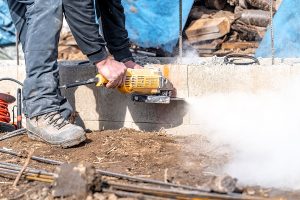
The best way to remove carpet glue is to hire a professional concrete grinder to come out and grind your floor. Not only will this process remove any glue residue on your floor, but it will also properly prepare it for an epoxy coating application.
Advantages of grinding include:
- Removes glue residue
- Opens up the pores of the concrete
- Provides proper surface profile
- Improves epoxy adhesion
- Removes weak surface layer of concrete
- Overall better appearance
Chemical stripping methods will simply soften the glue, but grinding will physically remove it.
Professional grinding creates the cleanest surface for epoxy coatings to be applied to.
Are Chemical Strippers a Good Alternative?
Using chemicals to remove carpet glue can create problems of its own.
Many glue-stripping chemicals will leave behind a residue that can also reduce epoxy adhesion. Sometimes when you think the glue is gone, the chemical used to strip it away is still embedded in the concrete.
Other issues associated with chemical glue stripping include:
- Chemical contamination
- Bonding failures
- Moisture problems
- Additional cleaning
- Increased preparation time
This is another reason many epoxy contractors prefer to have the glue ground off.
What if Epoxy Is Applied Over Glue?
Your epoxy coating will most likely fail much quicker than expected.
When epoxy is applied to carpet glue, the epoxy now has the glue as its weakest layer. As the floor expands and contracts with traffic, moisture, and temperature, the glue may begin to let go of the concrete.
Some signs of coating failure include:
- Peeling areas of epoxy
- Lifting edges
- Hollow sounding areas when tapped
- Blistering
- Cracking
- Complete delamination
Many times these issues have to be scraped off, and you’ll need to start the floor preparation process from square one.
Every concrete floor should be evaluated before an epoxy coating application.
Is It Worth Having the Floor Professionally Prepared?
We never suggest trying to cut corners when it comes to surface preparation.
Many flooring failures result from not preparing the surface properly. You can spend money on the highest quality epoxy products, but if your surface is not prepared correctly, you’ll likely experience failure. Proper floor preparation ensures your new epoxy floor has the best chance of performing as it should.
By properly preparing the floor, you decrease the chance of:
- Early flooring failure
- Peeling epoxy coatings
- Delamination
- Unprofessional appearance
- Costly repair jobs
If you’re wondering if you can apply epoxy over old carpet glue, the answer is probably not. For most homes and businesses, it’s not worth the risk to cut corners during this process. Professional concrete grinding provides the best foundation for any epoxy floor. Contact Custom Concrete Prep and Polish today to ensure your floor is properly prepared before epoxy application.