One of the most frequently encountered problems in remodeling and flooring installation projects is uneven floors. At first glance, these issues can appear to be simple cases of high spots, low spots, or areas that just need to be ground down or filled in. Floor leveling products offer solutions in many of these situations. But what happens when the floor isn’t level because of joist deflection?
You may need to do more than just apply floor leveling compound to raise dipping areas. That’s because movements in the joists cause the flooring above to bounce, dip, or sink. If subfloor and finished flooring aren’t adequately supported, the whole system can begin to move. Fixing dips and bumps may help temporarily, but until you can identify and address the underlying cause, your floors will likely never feel quite right.
What Is Joist Deflection?
Floor joists span between foundation walls, beams, or load-bearing walls to support everything above them. Over time, floor joists can bend, sag, or flex when too much weight is applied. This movement is called deflection.
Excessive joist deflection often becomes noticeable over time as the flooring begins to show signs of the movement. Floors with weak support often feel bouncy, have visible dips or soft spots, and may become increasingly uneven as flooring materials wear down or fail.
Signs That Joist Deflection May Be the Problem
Most uneven floors can be traced back to surface irregularities in the substrate. However, there are a few tell-tale signs that deflection may be causing problems.
Homeowners might notice:
- Floors that bounce when walked on
- Sagging that extends across wide areas
- Cracked grout or loose tiles
- Doors that stick or will no longer close
- Floors that seem to keep sinking or settling
- Visible dips between walls or beams
These issues often indicate support problems that need to be investigated before working on leveling the floor.
Why Self-Leveling Underlayment Is Not Always the Answer
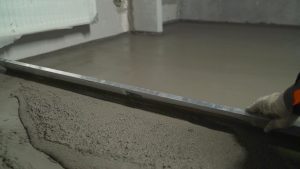
Self-leveling underlayment is a great way to fix many floor issues. Pourable-grade additives can help level low areas and create smooth surfaces for tile, wood, carpet, and other flooring materials.
However, underneath it all, self-leveling material cannot prevent structural movement. If joists continue to bounce or deflect after installation, the flooring system will continue to rise and fall. Eventually, movement in the joists will cause your newly poured underlayment to fail.
Imagine how frustrating it would be to pay for floor leveling only to have your floors become uneven again. That’s why many flooring contractors will evaluate surfaces to determine if they’re stable enough to work with.
Understanding the Difference Between Flat and Stable
Flat refers to how level a floor is, while stable describes how much movement a floor experiences.
Floor leveling compounds improve flatness but will do nothing to correct deflection or support problems. That’s why most flooring products come with installation guidelines that include requirements for both.
If a floor is not stable enough to prevent excessive deflection, cracks and failures can develop in the flooring system. Movement in the subfloor can still sometimes be felt through the finished flooring.
Common Causes of Excessive Joist Deflection
There are many reasons floor joists deflect or move over time. One common issue in older homes is simply age and wear. Natural settling of the home may also cause the floor to shift slowly.
Some other common problems include:
- Joists that are too small
- Span distance that is too great
- Water damage or rot
- Damage from insects
- Structural changes
- Added load from remodeling or renovation
Once you know why deflection is happening, you can identify the best way to fix it.
Structural Repairs Often Come Before Floor Leveling
If your floors are deflecting excessively, your floor’s structure will need to be strengthened before any leveling project can begin. There are multiple ways to correct framing issues like this.
Your contractor may recommend sistering joists to provide more support, adding a beam in the center of a room, shortening span distances, or adding additional support below the floor.
These corrections should alleviate most deflection problems by upgrading the structural integrity of the floor system.
How Floor Leveling Fits into the Process
Once structural issues are resolved, you can begin to address surface imperfections. Contractors will assess how level your floor is and recommend different prep methods based on the condition they find.
If your floor has dips and peaks, they may need to grind down the high spots and fill in the low areas. In some cases, they may recommend using a pourable, self-leveling underlayment.
Either way, by separating structural issues from cosmetic prep, you can ensure that the right solution is provided to correct your floor’s problems.
Flooring Materials Are Less Forgiving Than Ever
Flooring materials these days often have very specific requirements for the substrate they’re installed over. Material manufacturers specify minimum flatness requirements because their products do not perform well over uneven floors.
Large format tile, luxury vinyl plank, engineered hardwood, and polished concrete are just a few examples of flooring materials that require smooth surfaces. Movement from deflection can cause these materials to crack, separate, or wear unevenly.
Even if your floors feel fine to walk on, your new flooring may suffer if deflection problems are not addressed before installation.
That’s why it’s so important to have your floor evaluated by a professional before beginning any project.
You don’t want to invest time and money into installing new floors only to have them fail because of preexisting conditions. Proper floor preparation is almost always less expensive than replacing floors after they’ve already been installed.
Why Professional Assessment Matters
It can be difficult to determine what’s causing your floors to be uneven. While some issues are obvious, others may be less clear.
Flooring professionals use tools to measure unevenness and transfer the readings to a map for analysis. Depending on what they find, they may be able to recommend a solution. However, if there are structural issues, they may need to consult with a framing specialist before beginning work.
Flooring contractors don’t want to apply floor leveling products just to have them fail after the job is completed. By determining the cause of your floor’s problem, they can provide the right solution to your floor’s problems.
Address the Cause Before the Surface
So, how do you level a floor when joist deflection is the real problem? You don’t! At least not until you can fix the cause of the deflection. Pouring self-leveling underlayment may help build up dips in your flooring. However, it won’t stop your joists from moving.
By addressing the underlying cause of your floor’s problems, you can ensure that your floor will be flat AND stable. Custom Concrete Prep & Polish can help you do just that!
Trust Custom Concrete Prep & Polish for Expert Floor Evaluation
Here at Custom Concrete Prep & Polish, we know that every floor prep project should start with the proper diagnosis. By evaluating both the visible issues with your flooring and the factors that are not visible, we can determine what needs to be done to prepare your floor.
Whether you need your floors ground, leveled, polished, or prepared for new flooring, we’ll make sure the problem is corrected the first time. Don’t worry about DIYing these repairs if you’re unsure of the cause. Contact us today to learn more about our services and set your mind at ease!
If your floors aren’t level and you’re not sure if the problem is with the surface or the structure of your home, contact us here at Custom Concrete Prep & Polish. We’ll let you know what’s causing your uneven floor and provide your best options for a permanent solution.